Thursday, October 17, 2019

66.

We’re writing food commentaries in my college composition class, inspired by Geetha Kothari’s “If You Are What You Eat, then What Am I?”

This is a group of lovely mostly seniors. While I type this, they furiously finish their drafts.

We started class with a list of lessons we can take from Kothari’s piece, and stopped on using symbolic elements of the food. I tried to use the example of mashed potatoes.

“So, if we are using mashed potatoes to symbolize a relationship, let’s think about the type of mashed potatoes we’re dealing with. Now there are those smooth, perfect mashed potatoes, peeled of course--or those chunkier potatoes with the skins on. This is the kind I make because I am lazy.” I neglected to mention that I prefer them as well. 

Nearly all the students grimaced. Apparently they are not into rustic smashed potatoes.

“Okay, so if this relationship is symbolized by smooth and perfect potatoes, what would you assume about it?”

Alex pipes up, “They’re good!”

I get defensive. “My potatoes are good, too!”

“Made with care and love!” another student pipes up.

After a feigned exasperation, I break down the symbol that was living in my head, redeeming my own potato choices. And by the end of the impromptu routine, we are all laughing and ready to write.

The keys are clicking; it is silent. Joy and vulnerability in a writing room cannot be overemphasized.

Tuesday, February 16, 2016

65.

Today, I helped some seventh grade boys with their writing after school. All four of these boys struggled to put words on the page in an organized fashion, let alone with the rich details that would have made their interview pieces sing. It was a daunting task, and I flitted about the room sitting with them one at a time for five minutes at a time, trying to answer their questions from across the room so they could keep moving.

It was an exhausting hour. But we made some teeny tiny baby steps. One student figured out that telling the story of his parents’ divorce might be an important element of writing about their marriage. Another finally changed a question into a sentence without my help. The biggest breakthrough was with Lucas, whose draft was singular sentences grouped into random paragraphs at the beginning of the hour. But by the end of the hour, he was moving his details around so they fit into some semblance of groupings. He was writing follow-up questions in his document, carefully placing them so they’d be in the right place in his paragraph.

These little writing conferences were exactly what I needed after a day of grown-up talk about data and policies in our building leadership team (full of individuals whom I respect greatly, by the way). It was just a strange juxtaposition. We spent our day talking about these boys--these children who struggle with writing--and discussing whether and how they should be penalized for showing up to class without their assignments done. They were not in detention; they were in learning lab for help. And they mostly worked away without complaining.

It just makes me think about the vast differences between the children in our classrooms and how daunting it can be to make a drop in the bucket of the differentiation that needs to occur. I’m sure these boys, who struggle to write sentences, sit alongside kids who can churn out blissful, detailed paragraphs in minutes. Yet they are in the same grade, the same class because they can learn from one another. There is no focal point to this story other than to remind myself that the work is with the individual students, every single time. There’s a book I haven’t read by a teacher whom I believe no longer teaches called There Are No Shortcuts, which is true and heartbreaking. It’s a good thing the work--when it’s working--feels so good.

Sunday, February 14, 2016

64.

Friday was a great day. A great, great day.

Fridays, we read. This week, students set goals for the number of books they plan to read this semester, and the date they believed they would finish their current book.  I spent their reading period walking the room, talking to students about these goals, making sure they were both feasible and challenging. These conversations inevitably led to recommendations--”Oh, when you finish this, you HAVE to read _______!”

My favorite conversation of the day:
Student: “I want a story that has deep, real romance.”
Me: “Oh, you have to read Eleanor and Park. You have to read it right now. And maybe Delirium because it questions the idea of love and asks what happens if it’s missing from society. Check them both out and see what you think.”
At the end of the hour, I said, “Which are you going to choose?”
Student: “I’m taking them both.”

Moments like these all day long made me feel like I was doing exactly the right thing for kids as readers. But with every great conversation came a hint of guilt, thinking about why I hadn’t had that conversation sooner. Maybe the aforementioned student could have been hooked into one of these books earlier and she’d spend less time on her Chromebook if I’d made time for these reading conferences earlier in the school year.

The ideal and the reality. The reality is that it’s taken this long into the year for my fourth hour class to be able to read independently while I confer with students. They are a busy bunch, and any amount of whispering breaks the reading magic and sends the message that reading isn’t valuable. So they’ve missed out on reading conferences because they will read if they have the time. Today, though, I decided it was right to take the plunge, to tell them all of my concerns about conferences, to lay the expectation that they would still read in spite of the little whispers, and for the most part they did it. There was more student whispering, but it didn’t break the reading magic.

The confident part of me wants to believe that I knew today was the day--that I could feel it in the room and knew they could handle it. The guilty, insecure part of me fears that I could have done this months ago and now I’ve missed too many teachable moments. The reality probably lies somewhere in the middle.

This is the power and the penance in teaching. Even when things go smashingly, they come with a hint of regret. Because what you’re doing right for this student is something another student didn’t get because you hadn’t figured it out yet, or your timing was off that time, or another sometimes inconclusive factor was different. Most of the time, I do a pretty good job of living the Maya Angelou quote, “Do the best you can until you know better. Then, when you know better, do better.” I know that students have hundreds of teachers over their lives, and I am only one of them. But there are moments when I wallow in the idea that I am their only English teacher this year, concerned that I have harmed them with less-than-ideal pedagogy.

One of my master’s research paper tenants about how to sustain yourself in the classroom was about accepting ambiguity, living comfortably with the questions in this wonderful work. But there are days that questions feel like too much to manage. I want to live in that reading conference with Samantha and enjoy the good that came of it without beating myself up for all that I cannot do. Some days it is easier than others.

Friday, January 29, 2016

63.

I learned today that I develop a crease near my chin before I start to cry. I learned this because my friend Abby saw it in my face at our GSA meeting.

It was a relatively simple activity. Students took 3 minutes to brainstorm on each of four prompts (this idea is picked up from somewhere--can’t attribute it correctly, but it’s not mine, just to be clear): what I wish my parents knew, what I wish my teachers knew, what I wish my peers knew, and what I wish I knew. After students listed, quickwrote, whatever… they chose one sentence to anonymously dump into a collective bucket, which our student leaders read aloud. Kids (and teachers) in the circle raised their hands if they could identify with the statement or they had ever felt that way.

I am sitting next to Louis, a student I adore in class. His wit sparkles; he has his own mind. But I often wonder if he respects me as a teacher, if he puts me in the category of people who are trying to ruin his life and who don’t understand him. He’s painfully bright, aware of everything around him, a harsh critic. But he’s the kind of critic who you want to impress. Sylvia reads the next one aloud: “I wish my teachers knew how much they mean to me and how much I appreciate them.”

We are sitting cross-legged on the floor. He kicks my knee with his foot and turns his head to make eye contact, smirking. This is the loudest thank you I have received this year. My husband asked if it could have been an accident. It was not.

The crease near my chin develops. I am reminded by the most important stakeholder in this whole public education business that my work matters and I am doing something right.

It occurs to me that we teachers are a pretty easy bunch to please.

Tuesday, December 1, 2015

62.

Maybe you’re a teacher who values independent reading but is rubbish at assessing it. You don’t know if and how it should be graded, so you go back and forth and try different things each year but never arrive on anything you like. As a result, you’re not sure half of your students are reading outside of class, but you keep plugging away, placing authentic value on it: giving book talks, talking with students about books they might like and definitely should read. You keep setting aside class time to read.


Maybe you have a first hour that is a bunch of tired squirrels. They are beautiful people with rich, full lives, but these lives are frequently just going through the motions of English. During independent reading time, you sometimes have to shush them; every few weeks you sentence them to their desks instead of the freedom of the floor or the couch just to remind them that READING is the point. Sitting on a pillow is not the point.


Today is the first reading time since Thanksgiving break, and today is their first chance to move around the room in a while. They follow the two-feet-from-a-peer rule. You walk around the room, logging their titles and pages on your trusty clipboard, hoping that you looking over their shoulder twice a week will push them to put down that Chromebook and read in study hall if they weren’t doing so already.

When you finish, there are still five minutes left in the short reading period. You grab a book, perch on a stool, reading and breathing with them, noticing the quiet in the room. You look around. Eyes are locked in books. They are learning that reading matters, reading holds joy. This is the room you wish the other teachers could experience--the silent sense of everyone in their own little world, somehow together.

Tuesday, November 24, 2015

61.

Today we read “Choose to Be Grateful. It will Make You Happier.” as a lead in to the students’ Thanksgiving break. We’ve been working on Reading Nonfiction stance questions and Signposts, and I wanted to get in another practice opportunity before break. But I mostly wanted to plan the seed of gratitude in the hearts and minds of my students.

The article indicates that behaviors can trick us into feeling positively. There’s an example in the piece referring to a 1993 experiment in which “human subjects smile[d] forcibly for 20 seconds while tensing facial muscles,” so my students and I decided to give it a try. I watch the clock while grimace/smiling, calling out time intervals. Some students did not participate. Many did. Some had to turn away from the rest of the room, so they could maintain their clenched faces without busting into laughter.

And when we released, we laughed together. The general consensus was that it worked, overall. We could not determine, though, if it was due to the silliness of having to stare across the room at someone smile/grimacing, the feeling of pent-up laughter, or the giggles that came with the release. While I’m not sure we were all convinced, it did feel good to just be silly together.

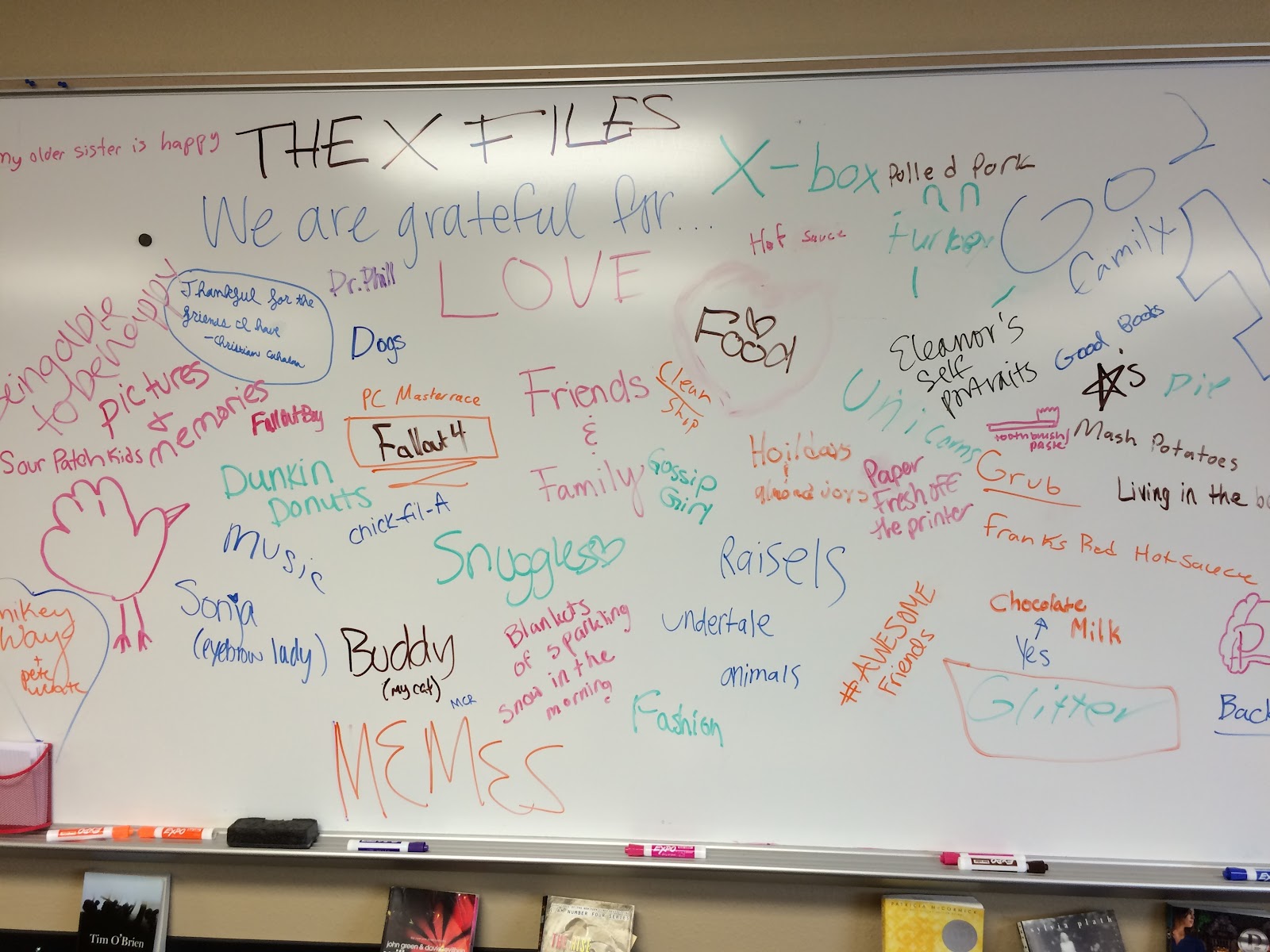
After reading the article, we added to a gratitude list, and then of course ran out of time before the narrowing and revision of writing part of the lesson, in which our gratitude snippets would be specific and original. I gave them time to write on the board anyway, and asked them to list their most “useless” or everyday item on their lists. In the spirit of sharing, here are some of the everyday elements of my work I take for granted: all the supplies/resources I need to teach well; reflective, professional colleagues; students who want to learn; a warm classroom; a perfect daily schedule; autonomy, autonomy, autonomy.

Here is a sample of the collective gratitude list from my ninth graders. Happy Thanksgiving, indeed.

IMG_3718.JPG

Wednesday, November 18, 2015

60.

Today I worked with our wonderful teacher librarian (and friend) on teaching students how to read nonfiction critically (using the language in this wonderful book).


We are working on a poster activity, where students annotate an article in groups.


It’s first hour, and kids are sleepy. The annotations are primarily surface-level at first, and it’s easy to see that this is still work for school: not for the pleasure of thinking deeply, not for life.


And then, we get to the last paragraph of the article. It’s about how social media addiction can lead to the same dangerous psychological issues as drinking, skipping school, and other high-risk behaviors for teens. I read this sentence, and the energy in the room shifts. Students who were a foot away from the article, waiting for the bell to ring, now step forward, lean in, put their pencils to the paper. They have something to say.

This was a small victory. There is still work to do. But we must continue putting students in positions where they have something to say.

Tuesday, November 17, 2015

59.

(After a three year hiatus, I’m back. No more than five minutes a day, just a quick sample of what’s going right in Room 9. I may do a longer reflective post about why I’m picking this back up later, but now, I’m just trying to redevelop the habit.)


Yesterday students submitted literary essays in my English 9 classes. It’s been an arduous process: four weeks of rereading, trying to think of something smart to say, supporting it with evidence, and THEN organizing it in a way that makes sense. And revising. And revising, And editing. I think it’s easy to forget how difficult all of this thinking work is--and that’s before we try to put words on the page in a cohesive manner.


Literary analysis feels like school writing (which I’m working on improving, by the way, but I’m not there yet). This is the kind of writing that students are not going to choose to read on their own. However, I wanted them to see the deep ideas they and their peers had come up with and celebrate the growth they made in their writing. So we did a symphony share. I asked each student to choose his/her favorite sentence from his/her essay (for craft or thinking or whatever they wanted), and we spent five minutes sharing them aloud in class before moving on to the next unit.


Here is a sampling of what I heard:


“We may try to hide it, but in the end we all have a little bit of Zaroff in us.” (From an essay about “The Most Dangerous Game”)
“Overcoming peer pressure can be difficult and people may give you a hard time about it, but would you rather feel the pride of helping someone out or feel the guilt of being responsible for a walking dead man?” (from an essay about “A Kind of Murder”)
“The beauty we find in others is blocked by what we want others to see in ourselves.” (From an essay about “The Scarlet Ibis”)

As we went around the room and students listened to one another, I was so impressed with the thinking their work showed. They were quiet, they saw their work had depth, and they drew out important reminders for us all to carry out into the world. Teenagers can be wise when we give them a chance.

Monday, August 20, 2012

58.

Here's a short and simple reminder with the start of a new school year.

I have a student, we'll call him Craig, whose name has come up constantly since he was a seventh grader. I can tell only three days in that he's full of energy, mischievous, and that the writing in my English class is not going to be his favorite thing.

I try to make a point to greet students at the door, especially early in the year when I am trying to learn names. Today, I asked him about his weekend on the way in, and he began telling me about an injury he received from one of his dangerous activities. I asked him a couple questions about another somewhat dangerous activity I thought he might be involved in, and he stood there and talked with me until the bell rang.

Obviously this was good for our rapport, which will make everything about instruction easier in the days to come. But there's something else. Today students generated their own ideas for writing. Craig is a kid who might sit there, claiming he has nothing to write about. But he immediately started working with ideas about one of his dangerous activities, and he did an awesome job. 

It's important to remember that some kids have to talk before they can write. And in order to talk, they might need someone to listen.

Saturday, February 25, 2012

57.

I know, I've been gone a while. And I'm about to go on maternity leave, so it's doubtful there will be many teaching stories until next August. But this one kid has been on my mind, and I've been wanting to write about him, so I am giving in and just writing one post (that will make 2 this year?). Hopefully I'll be better next school year about logging these moments.

Anyway, let's talk about Charlie. Charlie has major work completion problems. He fails classes without thinking about it. He draws these amazing pictures during class, and I know that even though the game of school doesn't work for him, he could do great things someday if he could just figure out that some deadlines are important. I've been reading his fiction and poetry and talking about books with him for two years. But he's still failing my class.

We are writing character analyses about Romeo and Juliet right now. (Well, most of us are finished. Not Charlie.) I know that literary analysis is not the type of writing that moves and inspires people, but I can justify its worth for the thought process kids must undergo and the way it prepares them for so much of the "school writing" they will have to do. It is also a formula that once students learn, they continue to grow in confidence that they can put cohesive, supportive ideas on the page. So I acknowledge that kids should write MORE than literary analysis, but I think it has its place in the ninth grade English classroom.

Charlie sees no value in this type of school writing. But he has to pass my class. I keep him after school only to discover that he has not even started coming up with evidence to support any idea. I curse myself for not seeing this at any point during our three days of in-class work time (God forbid I was helping kids with their hands in the air), but then I lay into him about his work habits and how scared I am for his future.

"You can't keep doing this, Charlie. You can't just sit and do nothing for three days and keep expecting people to help you pick up the pieces after the fact. It is not okay. And I know that this type of writing is not ever going to to excite you the way that fiction does, but part of growing up is just doing things you don't want to do." There was probably more, but that was the gist of it. My frustration is palpable. (I am usually pretty good about giving kids infinite chances--for better or for worse--so when I am seriously irritated, I think kids notice.)

Charlie asked to work in the other ninth grade teacher's room. And I was actually grateful, even though I knew it was probably because I had hurt his feelings.

He came in to see me before he left, and we went over his outline and plan for the weekend. I pretended to believe him when he said he would get it done. I reiterated the points of my earlier soapbox speech, but I adjusted it to value him. "You are such a perfectionist. And you have writing in your life that you DO value, so much, that this type of school writing might always be a bore. You might not be able to sit around and get inspired. You might just have to pick a topic that you don't care about that much, but you can finish the assignment about, and just do the work. As your writing teacher, I hate to tell you to just settle for a topic, but it may be the only way that you can even get started."

He smiled. "I know that you think that's like the worst thing to say as a writing teacher. But you know me so well as a writer. And a person."

And just like that, Charlie can have a million more chances. And I will keep thinking about how I can make literary analysis a bit more applicable to his life.

Tuesday, October 4, 2011

56.

I'm back in the classroom after a six-week stint of primarily mentoring a student teacher, and it feels great.  Kids are wonderful.

Today, we kicked off our poetry unit by discussing Bob Hicok's "In the Loop," a haunting piece about the Virginia Tech shootings.  The first time discussing a poem in my class is important to me because I want to emphasize that we talk about poems because it's a good thing to do: it helps us understand ourselves and each other better.  We don't just do it because we're trying to understand a rhyme scheme.  Approaching poetry this way makes it less intimidating, too.  In fact, I introduced the poem by saying that it was one I read this summer and couldn't stop thinking about.  I brought it to class because I wanted to see what they thought and see if they could help me answer some of my questions.

(If you haven't read the linked poem, go do it now.  It's worth a minute of your time, and you need it to participate in the next section.)

The simile that makes everyone think is the scarf on the train.  I got my wish that I would have more clarity after discussing this with my students because they had so many great ideas.

"Maybe the scarf is the shooter, and it's like, how no one really sees a scarf left behind even though the train is going.  Like life is moving all around him and no one sees him."

"I think the train is like how life just has to keep moving forward, like a train going to its stops.  But when you leave a scarf on a train, you're really sad at first, but then you just get over it.  Like most people in the country were really sad at first about the shootings, but then they just got over it and moved on."

After our discussion, we walked to the library to renew books.  Two (not particularly studious) boys in one of my classes whispered all the way down the hall about lines they were thinking about in the poem, lines they thought they had "figured out."  To see them so excited, thinking so hard about words: that is why I teach.  Kids make poetry fresh.

Tuesday, August 30, 2011

55.

In my writing elective class, we are beginning a poetry workshop.  I'm also trying to help the kids build a writing community and play together, so they'll feel comfortable sharing their work with one another.  Take a few minutes here and there to play now can make a huge difference in our productivity later on in a class like this.

The students are in four teams, writing examples of poetry terms on small white boards.  One team, which named themselves "Dumbledore's Army," has instantly bonded over Harry Potter, and every example they write down has something to do with Harry Potter. The current term: metaphor.  (If your figurative language terms are rusty, it's a comparison without using "like" or "as.")  The white board reads as follows:
Dumbledore is a pillar.
Umbridge is a toad.
Snape is a greasy frying pan.
Voldemort is a snake.
Nagini is actually a snake.

They could hardly get through the last one without busting up laughing.  While I agreed that it was a very clever addition to their board, they did not earn a point for metaphor.

Wednesday, August 24, 2011

54.

I know I never really signed off for the summer, but I'm back with stories from a new school year.  I'll try to post a wee bit more consistently than at the end of last year.  :)

Today, in an afternoon section of English 9, barriers came down.  I know it sounds dramatic, but it was dramatic.  It is scenes like this one that I live for in the classroom.  This class has a high proportion of kids that struggle with English and kids that lack confidence in writing as a result.  Students brought "Where I'm From" poems today, and I asked them to read them aloud in groups of four.  "Be brave!" I said, and each group member was to note at least one strong word choice in each poem read aloud.  After they'd had time to read and respond to each other's poems, each group had to choose one poem to share with the large group.  This poem could be read by the poet or by another group member.  

In one group, Chris, a student who has been a bit disruptive and surly for the last week shared his poem, which had great imagery and dark undertones that weren't present in some of the other poems.  The group agreed that Chris's poem should be shared, but Chris didn't want to read it.  Another boy, Dane, volunteered to read it for him. (Dane and Chris couldn't be further apart in terms of social circles and attitudes toward school.) Chris's face lit up and he agreed immediately. 

As the class applauded for the anonymous poet, Chris beamed.  

There were two other poems shared, written by students who lack confidence in writing, and they responded in the same way. I felt like they had a moment of thinking that maybe they could be successful in this class, in school.

As the students filed out of the classroom, Chris made his way to Dane.  "Thanks again for reading my poem," he said.  They had a genuine, unscripted moment of human interaction.  I was lucky enough to be there.

Wednesday, June 1, 2011

53.

So, I took a long break... and I'm about to take another long break from kids (4 days to go!), but I had a moment today worth sharing.  Not that I don't have moments worth sharing other days, but I haven't felt like writing them all down the last couple months.  My dear friend Donna has been trying to take the word "should" out of her vocabulary.  I suppose I followed suit a little and waited for the desire to come back.  I'm sorry I'm a lazy blogger.  Anyway, here's a story.

Yesterday we were reviewing for a test over our final short story.  I try to write broad questions about stories when I'm checking for understanding because I was always a kid who did the reading and who forgot the details when it came to reading quizzes.  We almost never have reading quizzes, so yesterday I read my students a question so they had an idea of how specific the questions on the test would be.  It was actual #5 on the test today, and they knew this.  I told them none of them better miss it.

Today, during the last class of the day, a student raised his hand.  I approached him and looked over his shoulder.

"I'm having a problem with one of the questions.  I'm not sure about it," he said.

"Okay," I said.  "What's your question?"

"I'm just really confused on number five."

He waited.

I read the words on his test, and as my eyes scanned over number five, he broke into a grin.  He couldn't hold his poker face any longer.

This humor, the end of the year connection, when every person is the building is counting down the days until summer, is the gift of working with teenagers in an environment you help create.

Wednesday, April 6, 2011

52.

It is conference week, friends, so it's very busy.  I have a quick story to share.

I always say that I am about building life-long readers, not life-long test takers, and I design my reading instruction that way.  I try to make reading a privilege and invite kids to try new books they might like.  I try to make close-reading a good experience to have so we can learn something about ourselves through literature--not so we can guess someone else's interpretation.   Students ask questions instead of answering them.  This is not always the best type of reading instruction for test preparation, and this year's political climate has make me second-guess what I'm doing--not a lot, but certainly enough to lose a little sleep over.

So I really needed this parent last night.

I needed her to sit down at my table and say, "I don't know what you did, but Luke is a reader now.  He asked for books for Christmas--full of small print and historical facts.  When we asked him if he was sure, he said, 'Yes.  I want to read about it because I want to learn about it.' He goes to his room at night to read for a half hour.  He never did these things before.  So thank you."

Luke would not be doing these things if my reading instruction were made of multiple choice questions to answer.

Tuesday, March 29, 2011

51.

Today we shared books with each other as a break from the difficult research essay writing we've been doing and as a way to jazz up our independent reading.

We used the format of a book pass, where students all bring a book (I also threw several in from my classroom library and the school library), and we pass them around in small groups, giving kids a chance to have exposure to 50 or more texts in a single class period.

The discouraging thing about teaching is when a couple students in each class go through the motions of looking at a couple books in each basket and then sit with a blank page in front of them.

It gets more encouraging when students with discerning taste walk out with three or four books on their lists.  They will have a book on the back burner, and maybe they will even look forward to it.

My favorite part about a book pass, however, is when students (and this is at least a third in each class) are just hungry for reading material, and they write down 20-30 books.  One student in my last class of the day couldn't wait to check something out from the classroom library: she had to take it home that night.

A hunger for books is what I hope to instill in as many students as I possibly can.

Monday, March 28, 2011

50.

I spent this evening with the delightful Ted Kooser, who reminded me of some tenants of teaching poetry and writing.  I plan to share them with my students tomorrow, and thought I'd share them with you tonight.

On teaching poetry and the experiences he wants kids to have with reading poetry:
"I want them to take pleasure it it.  The minute the poem begins to become a problem to solve, it's over."

On writing:
"I think we all ought to be writing about our families."  He said something about a memory you'd scribble on a piece of paper and stick into a drawer.  Years after the family members are gone, someone finds the piece, and "all of a sudden, back into the light they come."

"I love to write about the most ordinary things there are."

A glorious, refreshing evening.

Thursday, March 24, 2011

49.

At the end of class, I remind my students of tomorrow's change in class location.  "So, where are we meeting tomorrow?"

"Media Center!" most of the students yell in unison.

"Texas Roadhouse!" says one small voice.

"Yeah, and you can buy us all lunch on your HUGE teacher's salary!" one kid chimes in with a devilish grin in his eye.  His smile and his tone make it 100% clear that he's being sarcastic.

The kids are pretty informed.  I can tell many of them have seen the anti-teacher garbage in the news based on the jokes they're making.  "You even get health care!" one kid says.

The laughter reminded me that they don't think I'm milking the system.  They don't question my motives for being there.  They don't question the hours I work when I make it a priority to return their research notes so they can work on their essays during break.

THEY are the reason I teach.

Wednesday, March 23, 2011

48.


Today weighed heavy.

After reading student writing that broke my heart, a conversation with a student left me unsure how to help, what advice to give.

I told the student this, and said that I would consult outside sources and check back in. 

“It’s okay,” the student assured me.  “I know—this is going to sound like a pamphlet or something—but it really helps to just talk to a ‘trusted adult.’”  Yes, this was in air quotes.

These are the days I feel like all the training in the world couldn’t prepare a person to do this job.  Simultaneously, I know the most important thing I can do—in situations like this—is to listen.

Tuesday, March 22, 2011

47.

I've posted before about how sometimes working in a junior high forces me to enforce rules simply because kids have to receive more privileges as they get older.  I buy into this philosophy most of the time, but when my students are so thoughtfully considering their research topics and writing contemplative essays about how their thoughts and opinions have changed, it can be difficult to see them as beings that need to be "controlled."

Don't get me wrong: sometimes they do.  (For example, after school I witnessed two separate groups of seventh-grade boys in track sweats attempting to run down the hallways as fast as they could while carrying high-jump mats in from outside--as a group.  I just spent ten minutes trying to find an image online that can do this madness justice, but apparently people are too terrified to grab a camera in moments like this.)

Anyway, I digress.  Two stories in one today.

I was to review before-school procedures today.  It's rather complicated.  We don't have supervision in the halls, so students are supposed to get a pass to check out of the cafeteria or gym if they want to see a teacher before 8:05.  If they are found in the hallways without a pass, they will be immediately escorted to the morning detention room.  To be honest, the system now is better than the system used to be. Without passes, you couldn't tell if a kid had checked out of the cafeteria or not, so people that generally trusted kids they didn't know didn't do anything to kids who appeared to be on their way to see a teacher, and teachers that don't... well, those kids ended up in morning detention.

The sweet moment of reviewing these expectations came from the vast number of questions my students had when I was done with my speech.  "If we need to drop a band instrument off, should we do it before or after we see a teacher?"

"Can we stop at our lockers before we go see a teacher?"

"What if the teacher isn't in their room?  How do we get back to the cafeteria?"

I had to laugh at our work on figuring out ways to "get back" to the cafeteria as if it were across hot lava.

You might think my kids were dreaming up ridiculous scenarios to waste class time. (Well, maybe just a tiny little bit.  I'm working on convincing them I wasn't born yesterday.)  They were, for the most part, genuinely deeply concerned about how they could not get in trouble, how they could do the right thing.  And that is refreshing.